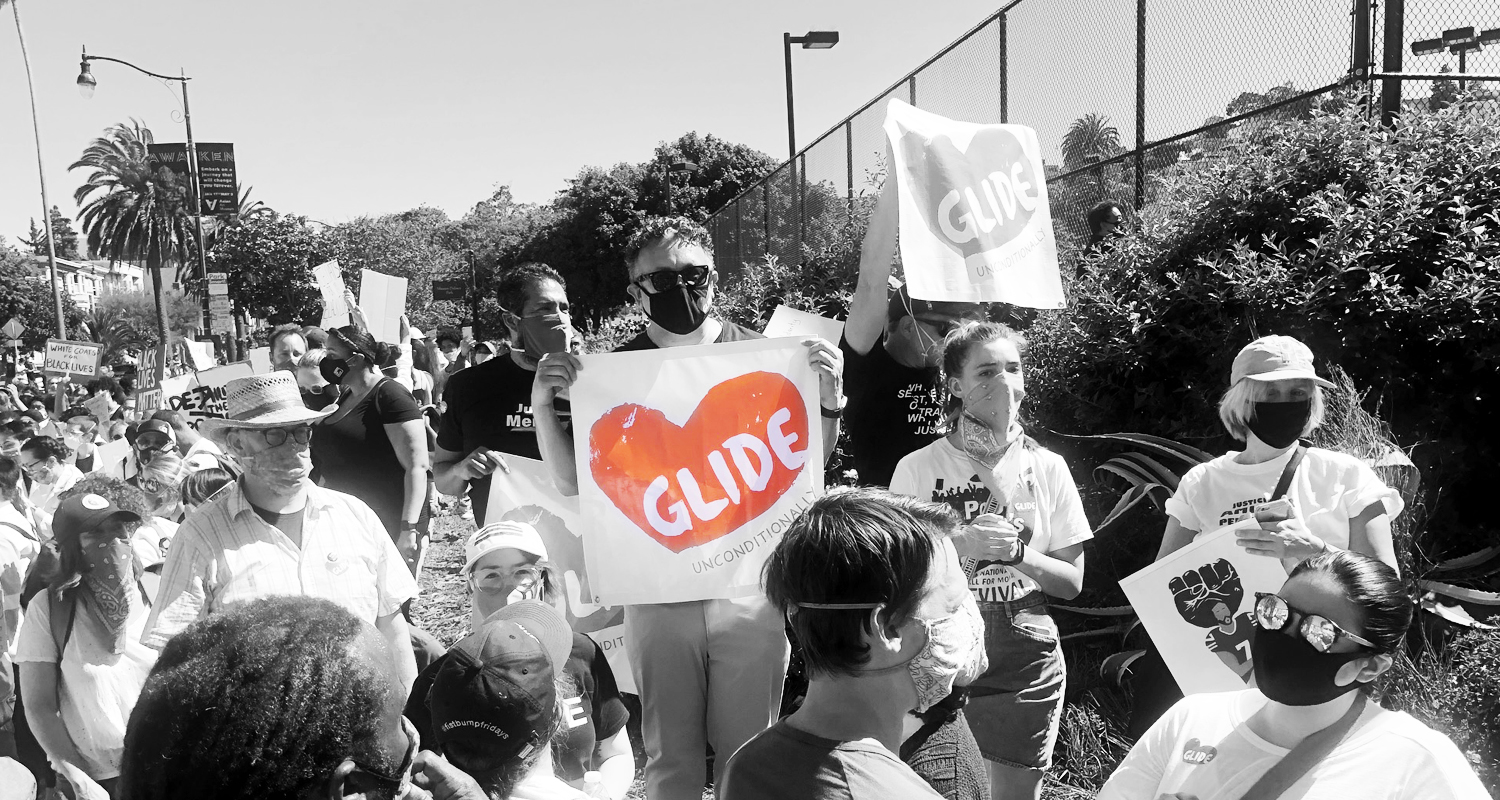

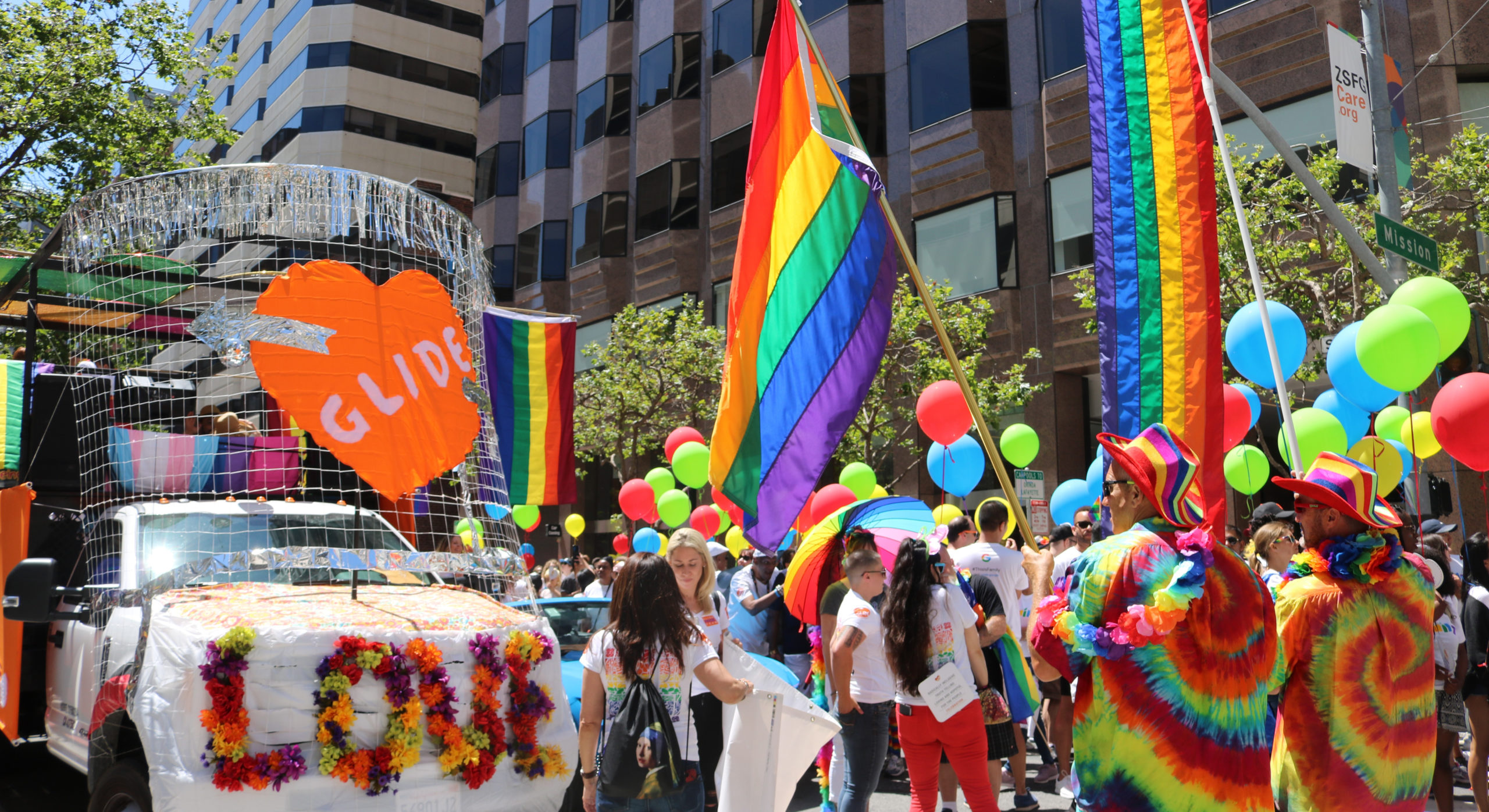
Amid the ongoing pandemic, the most profound social upheaval since the 1960s, we reflect on the origins of the LGBTQ liberation movement and GLIDE’s historical support of LGBTQ communities, including LGBTQ communities of color. Since the early 1960s, GLIDE has embraced the demand for and celebration of radical inclusivity.

GLIDE as a place for all people, whatever their experience or background or faith, goes back to 1963. In that year Reverend Cecil Williams joined a group of progressive pastors who together took an early stand for same sex couples, presiding over their weddings nearly four decades before the legalization of gay marriage in California.

At a time of intense criminalization of homosexuality, which included the practice of arrest and police violence leveled at LGBTQ communities, Rev. Williams and other GLIDE ministers were also among the founders of The Council on Religion and the Homosexual in 1964—along with the renowned LGBTQ rights pioneers and activists Del Martin and Phyllis Lyon. The San Francisco-based community organization joined LGBTQ activists and religious leaders in an effort to educate religious communities about gay and lesbian people and to speak out against homophobia and discrimination through inclusive, collective dialogue. It was the first organization in the U.S. to use “homosexual” as part of its name.


On January 1, 1965, the Council famously sponsored the Mardi Gras Ball at California Hall, to celebrate both the founding of the organization and the inclusivity it aimed to cultivate. Although the SFPD had issued a permit, the evening celebration was interrupted by a forceful police raid. The event would later become known as “San Francisco’s Stonewall.”

The following year, one of the first LGBTQ uprisings against police brutality took place in the heart of the Tenderloin, marking the beginning of the transgender liberation movement in San Francisco. The pivotal revolutionary act—among a group whose members included young people who had found a safe space and support at GLIDE—came to be known as the Compton’s Cafeteria Riot, which preceded by three years 1969’s famous Stonewall Riots in New York City. In her 2005 film, Screaming Queens: The Riot at Compton’s Cafeteria, filmmaker, author and professor Susan Stryker called the uprising, “the first known incident of collective militant queer resistance to police harassment in U.S. history.”

GLIDE’s commitment to the self-expression and liberation of each member of our community continues to this day. On August 26 of last year, the 53rd anniversary of the Compton’s Cafeteria Riot, GLIDE held a Reflection and Reconciliation Session in which leadership from the San Francisco Police Department (SFPD) listened to the lived experience of LGBTQ residents and formally apologized for a history of violence and injustice against the community. The community conversation was facilitated by GLIDE’s Minister of Celebration, Marvin K. White; Pastor Megan Rohrer, a trailblazing transgender Lutheran pastor and SFPD chaplain; and Commander Teresa Ewins, the highest-ranking member of the LGTBQ community in SFPD. Reconciliation is a road we’re still on, and one that requires real structural change. Meanwhile the hopes, needs and critiques that were courageously shared at the gathering were only the first in a planned series of ongoing listening sessions.

While we are a long way from justice and reconciliation, particularly for LGBTQ folks at the intersections of racial and economic injustice, vital victories continue to be won in the struggle for love and equality as the basis for a better world. In our second PRIDE Month during the struggle of the COVID-19 pandemic, we must remember to celebrate our victories — particularly the decisive 6-3 vote that came in June 2020, when the Supreme Court ruled that the section of the Civil Rights Act of 1964 that forbids discrimination in employment based on race, religion, national origin or sex extends to protections for gay and transgender people.

Even with this historic step forward, one which makes a profound difference in the lives of millions of people, it is still legal under federal law for landlords, stores, restaurants and hotels to discriminate against LGBTQ people.

We proudly celebrate the steps toward the better world we have fought for together with unconditional love and solidarity, and we also recognize that there is more to be done. The struggle continues. But this year’s Pride celebrations, both online and in the street, send the message loud-and-clear: The time for radical inclusivity is now!

By Erin Gaede
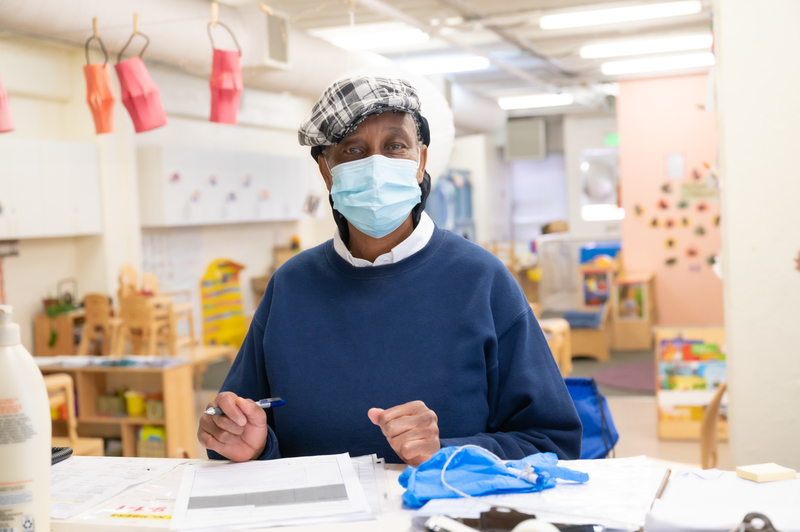
GLIDE’s Family, Youth and Childcare Center staff support families through exceptionally challenging times

Despite needing to temporarily pause all on-site programming, GLIDE’s Family Youth and Childcare Center (FYCC) has been busy supporting its families in ways tailored to the particular challenges—and increasing need—brought on by the COVID-19 crisis. From the first days of the shelter-in-place order, FYCC staff members mobilized to distribute food and other basic necessities from FYCC’s lobby door on Ellis Street, working tirelessly to provide vulnerable families and children in the Tenderloin with the support they desperately need.

“It was pouring rain on the first day of food distribution,” recalls FYCC Director Lanie Igtanloc of that afternoon in March. “I didn’t expect many families to come but, to my surprise, the parents were lined up.

“Despite the rain, you could see the tears and stress in their expressions,” she continues. “Many of them told me that they didn’t have the money to buy enough food or stock up on essentials. I just kept telling everyone the same thing, ‘We are here for you. We will continue to be here for you.’”

The coronavirus pandemic has given us all a new awareness of the landscape of limited choices. But for those whose choices were already highly restricted—low-income families whose lives were never safe or easy—the reality of this pandemic is starkly different. Navigating the structural disadvantages and restricted-access resources has only become more complex for people like FYCC’s hard-working but very-low-income parents, and the consequences of not succeeding have never been more dire. That’s why FYCC’s devoted staff have been stepping up.

Over 400 families are enrolled in FYCC. Before the arrival of the coronavirus, a typical weekday included afterschool programing for youth in grades K-5, a Family Resource Center offering parenting workshops and family case management, as well as licensed childcare and early education services for children 18 months to 5 years old. There were constantly family events and field trips happening simultaneously.

But in the last three months, the building has become unusually still, no longer animated by the joy and laughter of children or the multilingual conversations with parents picking up their kids or consulting with a teacher. Instead, all of this activity has had to adapt to the new circumstances brought on by pandemic.

“The building is typically so lively,” notes Anthony, the FYCC Building Coordinator. “As soon as you stepped inside, the space was alive with all the teachers and parents coming and going. Now it is quiet,” he says. “The silence stands out.”

Despite the silence on-site, Anthony and his colleagues have remained busy.

Many of the families who live in the Tenderloin, including many FYCC families, had jobs in the hospitality and service industries, and so were among the first to be out of work as the pandemic forced a general lockdown in the Bay Area.

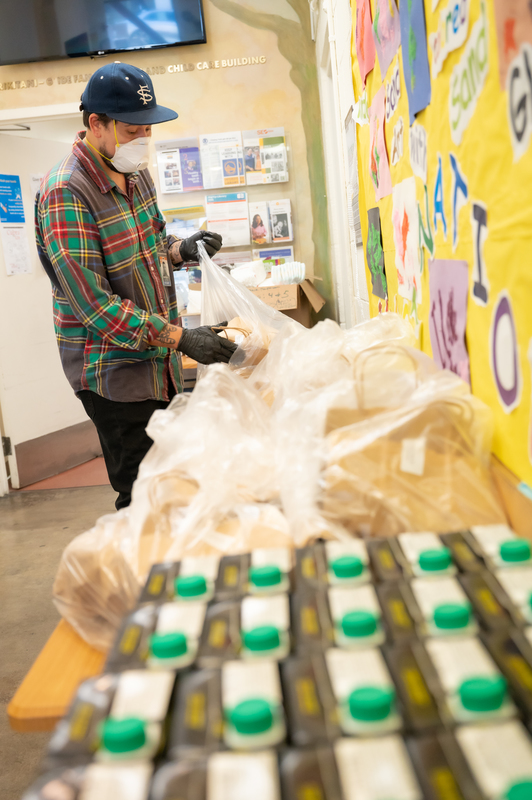
Since the start of the pandemic in March, Anthony has been overseeing the emergency food distribution program at FYCC. “I have years of experience with operations,” he explains. “But I had no idea how food distribution works. I just knew I had to jump in. We weren’t going to let any of our families go hungry.”

With the help of supporters like Project Isaiah and Gate Gourmet, First Five, GLIDE’s Daily Free Meals team, and generous donations from across our community, FYCC is able to distribute meals and critical supplies to families in the Tenderloin three days a week.

“We have been collecting feedback from parents on what to include in the distribution, to get a sense of what they really need,” Anthony explains. “The focus is on pantry items and dry goods, considering we don’t know how long this pandemic will go on.”

In the quest for creative solutions to the growing need, FYCC’s teachers have also started a series of online cooking classes, showing families how to prepare nutritious meals with the groceries they pick up at FYCC. Each bag includes a recipe tailored to the ingredients distributed that week and designed to ensure families get the nutrition they need despite the limited options available to unemployed parents.

Anthony makes care packages for distribution to families.

Helping families navigate resources and meet immediate needs

With many millions of Americans filing unemployment claims as a result of the COVID-19 crisis, more and more people are experiencing firsthand just how impersonal, invasive and confusing the process of receiving benefits can be.

“For the first two weeks, most the of the questions were about rent,” says Lanie. “We were overwhelmed with helping parents figure out how to apply for unemployment and navigate where to find financial resources.”

Of course, the pandemic also closed schools and daycares. And given the risk of contagion, support networks have become more limited. The stress of being unemployed in an increasingly precarious economy is compounded by having the children home all day, often in small, cramped spaces. And while the burdens of COVID-19 continue to mount for low-income families, immigrant families are facing a unique range of barriers.

“When school districts first started giving out meals, they required parents to bring a child and identification,” Lanie explains. “Many families were coming to FYCC for support because we don’t ask about their immigration status.” While the Unified School District eventually stopped asking for IDs, the trust established between the frontline staff at FYCC and families has proven to be essential in combatting the deepening inequality caused by the pandemic.

Beyond immediate needs

Selina is the Afterschool Program Manager and has worked at FYCC for over 11 years.

“I have known many of these families for years,” she says with affection in her voice. “They are basically an extension of my own family.”

FYCC teachers prioritize family engagement as part of a child’s education. Integral to the reinvention of afterschool online programming was the engagement of not only children, but their parents too. Through virtual platforms like Zoom and ClassDojo, parents and children bond in Baby and Me classes, read books together, and participate in science experiments and children’s homework assignments.

Technology poses an additional challenge to remote learning for low-income families. Many don’t have internet access or laptops. In an attempt to bridge the digital divide, FYCC staff are collaborating with the Unified School District as well as GLIDE’s Fund Development team to provide one laptop or tablet per family.

This online programming has proved especially important for immigrant families who relied on afterschool programs to help their children learn English. These online platforms are opening up new avenues for parents who previously were unable to participate in their children’s studies.

“Our entire staff speaks Spanish,” notes Selina, “but now the variety of linguistic options on these virtual platforms allow the families who speak Arabic and other languages to interact in ways they may not have felt comfortable with before.”

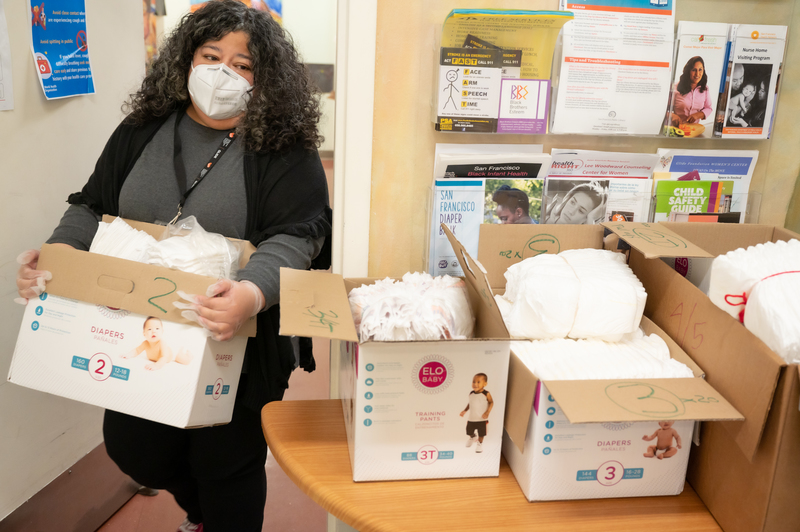
Theresa stocking up on necessities for young families.

In this together

As the shelter-in-place continues, FYCC staff members continue to improvise, expanding the range of available resources for the community, building up their inventory of everything from baby formula, feminine products, toilet paper and diapers to cleaning products, deodorant, information on dental resources, and ever more activities for the children—including books and art supplies.

The lift is a heavy one because the need is great.

“It often feels like we are walking a fine line of trying to provide everything but knowing we can’t,” admits Anthony with audible exhaustion. “We are doing the best we can to provide the resources most needed.”

As FYCC’s director, Lanie understands that her staff have much to deal with in their own lives, even as they devote themselves wholeheartedly to FYCC’s families.

“Many FYCC staff are in their 60s,” Lanie explains. “Most are living in the East Bay with long commutes with families of their own at home.”

“Not only are we fighting to advocate for low-income families in the Tenderloin, but we are trying not to become overwhelmed ourselves,” she says. “Each day requires motivation.”

She adds with pride, “The fact that my staff overcomes all the fear and all the obstacles for the sake of the welfare of families here at FYCC shows you the true power of community.”

By Erin Gaede

A message from GLIDE’s President and CEO


Dear Friends,

As the nation continues to demand change in the wake of the killings of George Floyd, Breonna Taylor and the countless other Black men and women whose lives have been cut short at the hands of police, GLIDE remains steadfast in our commitment to social and racial justice in all we do.

For nearly 60 years, GLIDE has been a leading social justice organization on the front lines fighting racism and promoting equality, radical inclusion, and unconditional love. Our work has taken many forms, from serving people on the streets and lifting people out of poverty and suffering, to protesting, advocating for policy solutions that change systems, and bringing hope, healing and inspiration with our legendary Sunday Celebrations.

At this critical moment, GLIDE reaffirms our commitment to Black, Brown, LGBTQIA, homeless, immigrant, and socially and economically marginalized individuals and families. Our staff makes this commitment every day in our programs, services, advocacy, community organizing and leadership.

  • Serving over 75% people of color, GLIDE’s services stabilize and lift up individuals and families struggling with the effects of systemic racism. Our integrated services include meals, harm reduction services, childcare, women and family services, case management, violence intervention, and housing resources.
  • GLIDE’s Center for Social Justice drives systemic change to overcome racism and inequity. In addition to shifting consciousness on racism and bridging the empathy gap, we lead advocacy and shape policy solutions to address homelessness, criminal justice reform, poverty, drug policy and the express needs of women and children of color.
  • GLIDE’s law enforcement training program interrupts patterns of discrimination and brutality. Rooted in empathy and service, it brings together police, district attorneys and other law enforcement professionals from around the country to come face-to-face, in service and dialogue, with people impacted by racism, homelessness, drug use disorders and more. Hosted in the Tenderloin, the program changes the perspectives of law enforcement officers and interrupts patterns of police brutality and discriminatory policing in communities of color.
  • GLIDE’s Racial Justice Pilgrimage Project promotes truth, justice and reconciliation, rooting participants in a deep understanding of our nation’s history of racism and its modern day persistence. With the aim of making progress against systemic racial violence and inequities, the journey begins with a deep examination of the history of racial oppression in the United States. Facilitated by GLIDE’s in-house racial and social justice experts, the project includes workshops, seminars and readings on the history of race and injustice. The program culminates with a group trip to Montgomery, Alabama, the heart of the Civil Rights Movement.
  • In partnership with UCSF, GLIDE is finding new ways to address systemic racial and economic inequities in health care. GLIDE is leading a group of senior healthcare leaders from UCSF through the Racial Justice Pilgrimage Project and ongoing trainings. In the coming year, 160 first-year UCSF medical students will make multiple visits to GLIDE as part of an experiential learning program. GLIDE and UCSF are also partnering to spur local government officials and the Department of Public Health to address systemic health inequities in San Francisco.
  • Leading social impact in the business sector. GLIDE is broadening our racial justice and empathy work to include transformative experiences for corporate leaders and their staffs. Similar to our work with healthcare leaders, GLIDE addresses inequities and empathy gaps in the corporate world through targeted trainings to top-level executives, as well as experiential work tied to GLIDE’s extensive volunteer opportunities on-site in the Tenderloin.

Whether in the daily work of our comprehensive services to the poor and marginalized or in our innovative trainings and public advocacy, GLIDE’s goal is to deepen understanding and empathy while increasing activism to address systemic injustices and policy reform.

We are right now in a defining moment for our country, in which the long struggle for racial equality is once again front and center in the nation’s consciousness and conscience. GLIDE remains committed, and we thank you for your continued support of our work.
 

In solidarity,

Karen Hanrahan
President & CEO

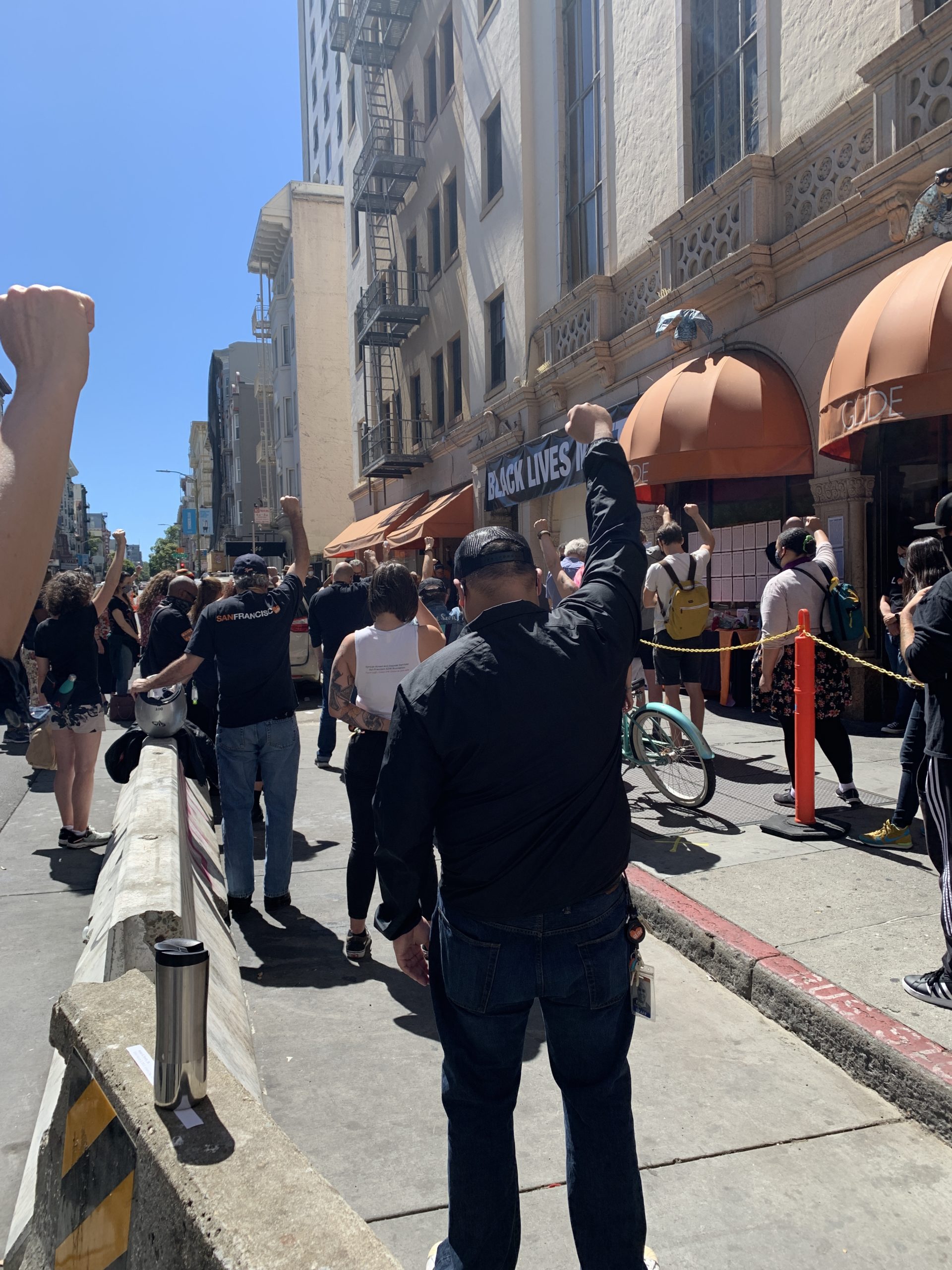
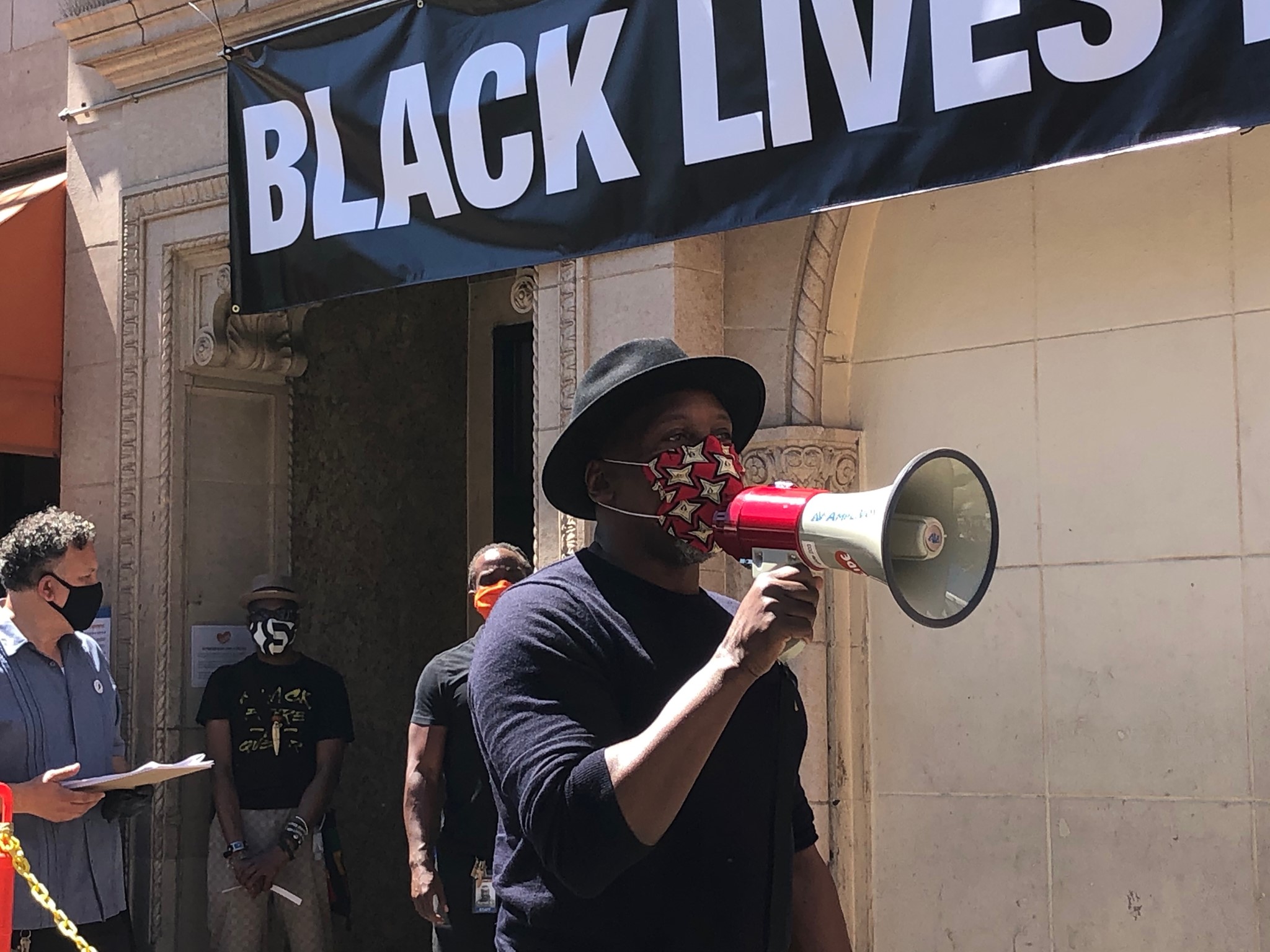
Minister Marvin K. White addressed GLIDE Staff at a vigil for Black lives lost to state and state-backed violence on June 9, 2020.

My job today is to remind you that the actions you take now and next are necessary. Because through your actions, you affirm that freedom is the goal and aim of this uprising. Yes, we are fighting for justice in the death of Ahmaud Arbery, George Floyd, Breonna Taylor, Tony McDade and Countless Named and Unnamed Black People Killed at the hands of the state and state actors but my job is to remind you that after justice, comes peace. And “after justice, comes peace” is a scientific and universal law right up there with Archimedes’ Principle of Buoyancy, Hooke’s Law of Elasticity, Bernoulli’s Law of Fluid Dynamics (Bernoulli’s Principle), Dalton’s Law of Partial Pressures and Fourier’s Law of Heat Conduction.

After justice, comes peace. Or out of the mouth of protestors, “No Justice, No Peace.” It’s not a threat, it’s holding Peace as the aim. It’s holding Peace as the truth! And peace is what we are fighting through the justice to get to and return to. And we’re close! How do I know? Because White Supremacy and Oppression rears its ugly head like a bully daring us to cross the bodies of murdered black people to get to Peace every time. And look at us, and look at y’all, standing up to police brutality, standing down racism, standing up to silence, and standing down white fragility. We close to Peace. Because Justice in the air.

And we do the many named and unnamed Black people, killed by the police, no favors, if we don’t move into the Peace that they were headed towards for over 400 years now! And Peace, across Faith, across Race, across Gender, across Sexuality, across Class, does not die with us. Death raises the possibility of Peace even more. Keep fighting for Peace.

No Justice…

No Peace…

No Justice…

No Peace…

No Justice…

No Peace…

No Justice…

No Peace…

No Justice…

No Peace…

https://www.youtube.com/watch?v=sEuxVoB6wOE

A letter to our community

Dear friends,

The pain of this last week is longstanding and deep within our community.

The unrest is the unrest of those who cannot rest.

None of us can rest until this murder and the long, long line of crimes against black and brown people move from being the inevitable to being the impossible in our country.

In the grief we feel for the loss of George Floyd—the incalculable value of his precious life—we hold, too, a profound grief for all the people of color, all the men and women, all the queer, trans and gender-non-conforming people who have had that knee on their neck unto death, too.

With a prescience that shakes us with sorrow and resolve all these many years later, Rev. Martin Luther King, Jr. warned, “As long as America postpones justice, we stand in the position of having these recurrences of violence and riots over and over again.”

We urge peace. And we know that the only basis for peace is justice.

We stand with the millions of people in this country, and around the world, in demanding justice—but with a special determination to act right here, right now in our own communities.

We must not let our humanity and all of our moral and practical energies stray from these facts (and many other terrible facts like them) about the conditions forced on our African American brothers and sisters:

— African Americans make up 5% of San Francisco’s population, yet represent 37% of those in our community experiencing homelessness.

— Nationally, African Americans are three times more likely to die from COVID19 than white Americans.

— African American imprisonment rate in the US is more than five times the rate among whites, and the rate at which they are shot and killed by police is more than twice as high as the rate for white Americans.

— Black women are three to four times more likely to die from pregnancy-related causes than white women, and twice as likely to die as women of other races.

— The 10 counties with the highest food insecurity rates in the nation are at least 60% African American.

The pain people are expressing in mass protests, the overwhelming majority of whom come together to express themselves in a peaceful and nonviolent way, is not new. The pain comes from centuries of systemic violence and police brutality against Black people.

GLIDE’s daily work and mission are focused on caring for, and walking with, those brutalized, traumatized, pushed out, or pushed to the ground by an unequal and unjust system.

We continue to strive toward a racial and social reality that embraces life, by truly loving and respecting each living soul.

There can be no rest and no peace without love, without justice.

Let us all recommit to seeing, again, in those who have been told otherwise, the remarkable and beautiful people they are. Let us say it again. Black Lives Matter. So that we might live fully and meaningfully in this supremely challenging time.

With love and solidarity,

Karen Hanrahan

President & CEO, GLIDE